Starting a workplace wellness program is one challenge. Keeping it useful and accessible over time is another.
New initiatives often generate enthusiasm, particularly when they introduce something employees have not experienced before. But continued participation requires an organization to consider how the program fits into everyday operations.
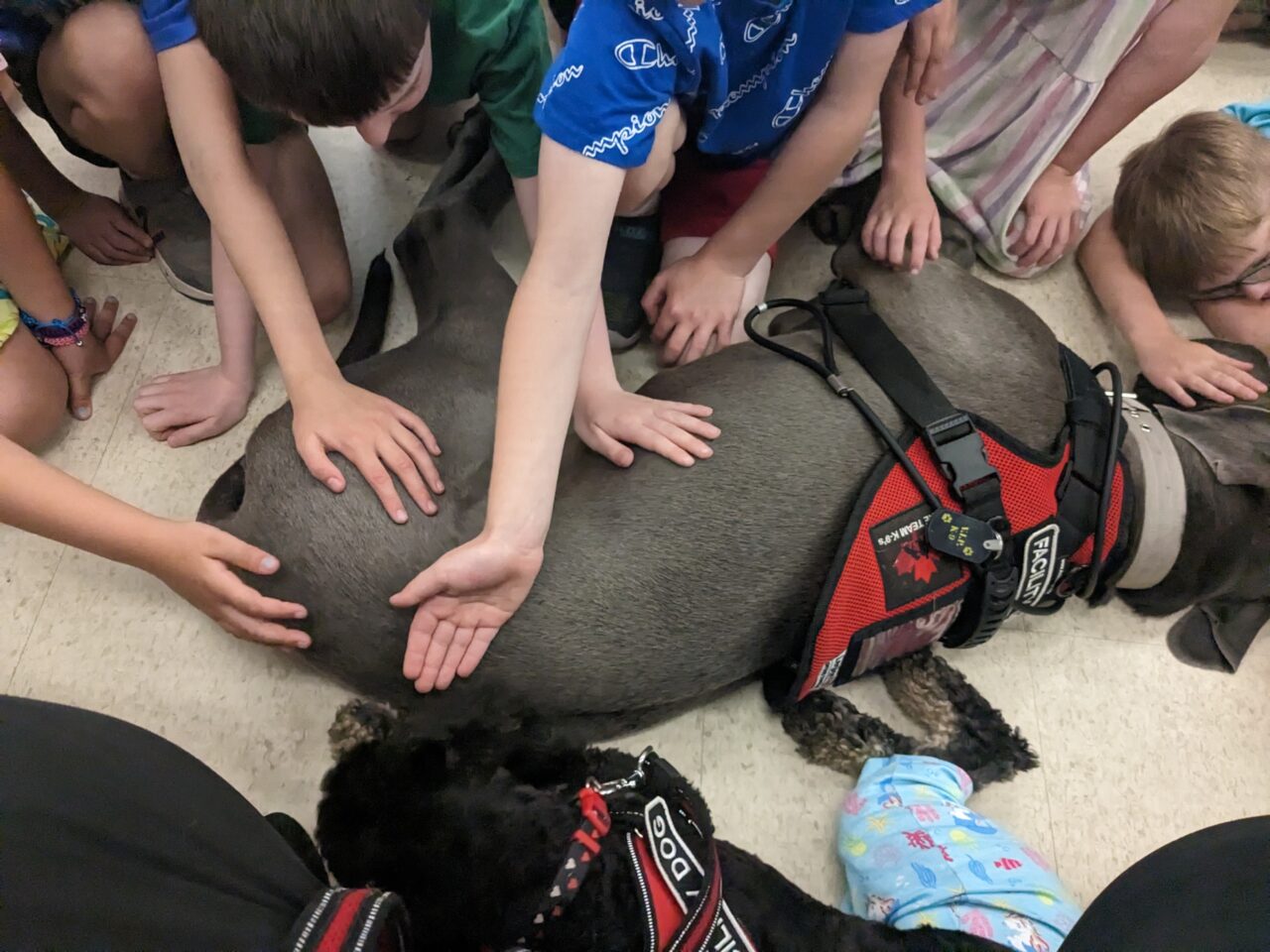
The University of British Columbia’s B.A.R.K. partnership with the Kelowna RCMP Detachment offers an example of a canine-assisted wellness initiative that continued well beyond its original research pilot.
From a Research Pilot to Regular Programming
The original 2018 study involved seven trained therapy dog and handler teams visiting the detachment weekly over eight weeks.
During that period, employees made 251 visits, representing 120 individual participants.
The researchers documented statistically significant reductions in immediate self-reported stress following the visits.
The program continued after the research pilot ended.
In its 2024–2025 annual report, UBC’s B.A.R.K. program documented regular drop-in sessions at the Kelowna RCMP Detachment.
During that reporting period, the program recorded:
- Five sessions.
- 365 visits.
- An average of 73 visits per session.
UBC also reported that the program had moved to a central, high-traffic location within the detachment to accommodate demand.
These figures demonstrate ongoing program use several years after the original pilot.
They do not establish whether individual employees experienced lasting mental health improvements, and the later attendance figures cannot be directly compared with the original pilot as though both periods involved identical conditions.
Why Continuity Matters
Workplace mental health needs do not arise only after major incidents.
Employees may experience ongoing pressures related to workload, organizational expectations, relationships, and the demands of their responsibilities.
Regularly scheduled wellness programming offers opportunities to participate before someone reaches a point of significant distress.
Repeated availability can also make a program familiar.
Employees learn when it operates, what to expect, and who is involved. Those who are not interested in participating initially may choose to attend later.
These are reasonable considerations for program design, although the Kelowna research did not independently test whether repeated availability increased trust or reduced stigma.
What Sustainable Facility Dog Programs Require
For facility dog programming, continuity depends on more than having a trained dog available.
Programs need qualified handlers, appropriate supervision, clear objectives, and reliable scheduling.
They also require animal welfare standards that recognize the demands placed on dogs working in busy environments.
Dogs need appropriate rest, opportunities to disengage, and handlers who can recognize behavioural signs of discomfort or fatigue.
Where facility dogs work alongside mental health professionals, the program must also address clinical scope, confidentiality, documentation, and referral procedures.
These requirements help ensure that the intervention remains appropriate for both the people participating and the dogs involved.
Evaluating More Than Attendance
Participation statistics tell us whether a program is being used.
To understand whether it is achieving its objectives, organizations need additional measures.
These might include changes in perceived stress, participant feedback, opportunities for connection, use of available resources, and the experiences of handlers and dogs.
Longer-term evaluation could also examine whether participation influences access to mental health services or other meaningful outcomes.
The Kelowna program demonstrates that canine-assisted workplace wellness can remain operational and attract participation over several years.
Its continuation is encouraging. Establishing its longer-term effects remains an important area for research.
References
Binfet, J.-T., Draper, Z. A., & Green, F. L. L. (2020). Stress reduction in law enforcement officers and staff through a canine-assisted intervention. Human-Animal Interaction Bulletin, 8(2), 34–52. https://doi.org/10.1079/hai.2020.0011
University of British Columbia Okanagan, B.A.R.K. Program. (2025). Annual report 2024/25. https://bark.ok.ubc.ca/wp-content/uploads/sites/148/2025/06/BARK_AnnualReport_24-25_Digital_WEB.pdf
