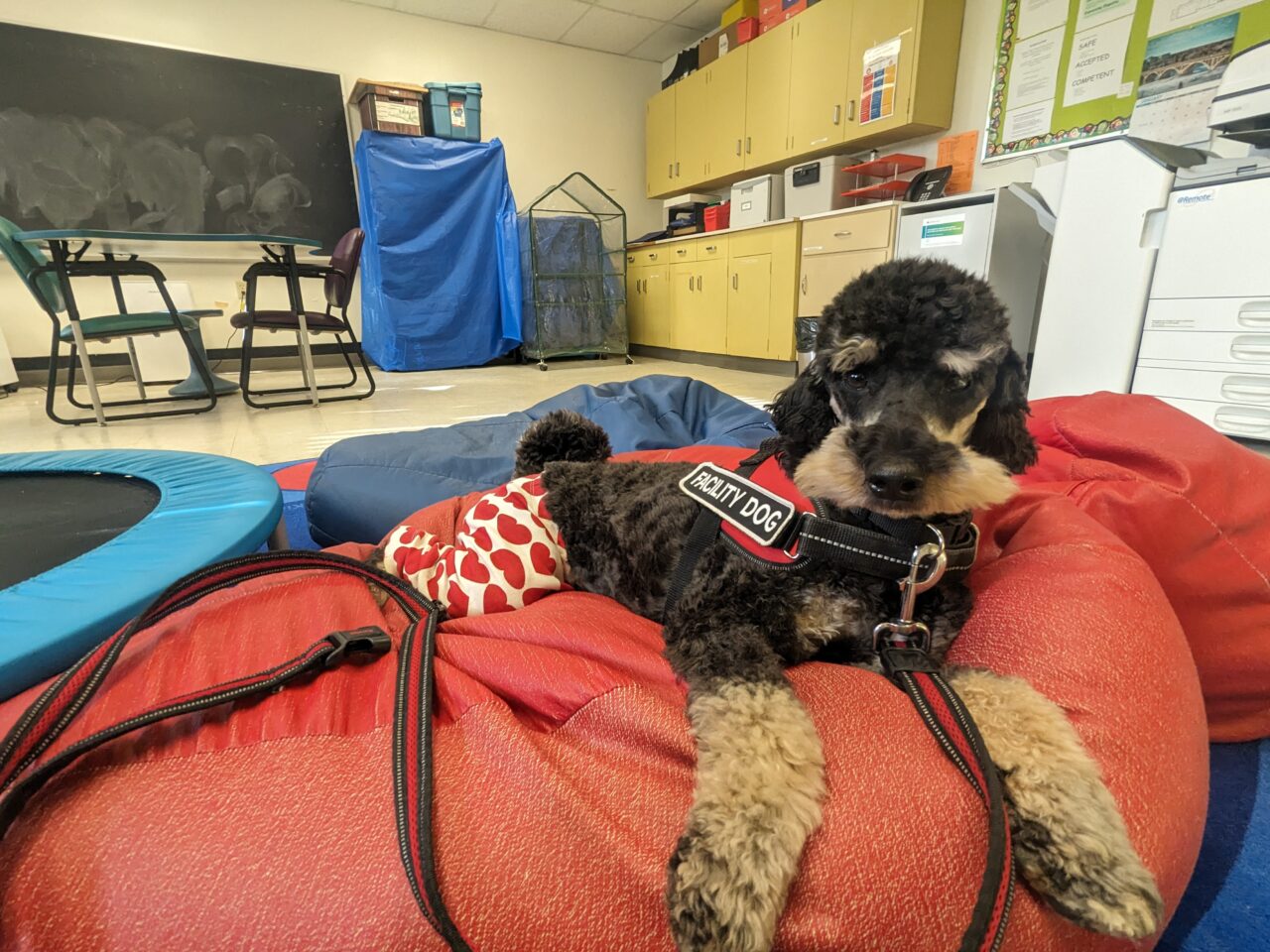
If you’ve encountered a dog visiting a hospital, school, or community event, you’ve probably heard it described as a therapy dog. These dogs and their handlers provide valuable opportunities for comfort, connection, and positive interaction.
Facility Dogs are sometimes mistaken for therapy dogs because they may work in many of the same environments. You might see either dog sitting beside someone experiencing distress, participating in a group activity, or interacting with people in a healthcare setting.
FTK9 Facility Dogs have a different training pathway and a more specialized operational role.
Our Operational Stress and Trauma Intervention Facility Dogs are trained to work alongside qualified health professionals and peer support personnel serving veterans, first responders, and their families. Their work extends beyond visits and social interaction to include trained tasks, structured interventions, and ongoing integration into the services their handlers provide.
What Does a Therapy Dog Do?
Therapy dogs are typically privately owned dogs with owners who enjoy volunteering.
They might visit hospitals, long-term care homes, schools, libraries, or workplaces. During these visits, people can spend time with the dog, offer affection, talk with the handler, or simply enjoy the interaction. There is no therapy dog certification, and a therapy dog may or may not have training. Organizations such as Pet Partners emphasize the importance of appropriate temperament, safe handling, animal welfare, and preparing both the dog and handler for these environments, but there is no standard test or training expectation for therapy dogs.
The term therapy dog does not, on its own, establish that the dog is performing clinical therapy or any theraputic activity. A visit with a therapy dog may be an animal-assisted activity, while a qualified professional may incorporate a dog into a structured therapeutic intervention.
Both applications can be valuable. The nature of the service depends on what the team is trained and qualified to provide.
FTK9 Facility Dogs Begin With Service Dog Training
Our Facility Dogs begin with the same foundational training as our Operational Stress Injury Service Dogs.
This includes the obedience, environmental stability, public behaviour, and task-training foundations needed for dogs working in demanding environments.
They then continue their training for a different assignment.
A psychiatric service dog is trained to assist an individual with a disability through tasks related to that person’s needs. The dog works in an ongoing partnership with that individual.
A Facility Dog must be prepared to work with multiple people, often in circumstances that change throughout the day.
One interaction might involve someone experiencing acute emotional distress. The next might involve a group of first responders participating in a structured activity. Later, the dog may be asked to perform a trained behaviour during a session with a mental health professional.
The dog must remain responsive to its handler while adapting appropriately to different people, environments, and activities.
Assistance Dogs International describes Facility Dogs as dogs trained to perform specific, skilled tasks in a variety of situations with multiple clients. The organization’s definition explicitly distinguishes this work from simply being present in a facility.
This is the training standard that informs the FTK9 Facility Dog model.
The Handler Is Part of the Intervention
At FTK9, we place considerable emphasis on the person working alongside the dog.
Our Facility Dogs are partnered with qualified mental health professionals or appropriately trained peer support personnel working with veterans and first responders.
The handler brings professional knowledge, an understanding of the population being served, and the skills required to determine how the dog can appropriately participate.
A psychotherapist might incorporate the dog into an intervention involving emotional regulation or interpersonal engagement. A peer support professional may use the dog’s trained behaviours during structured activities that encourage communication, participation, or connection.
The scope of the intervention is determined by the handler’s qualifications and responsibilities.
A peer support worker does not become a psychotherapist because they work with a Facility Dog. Likewise, the presence of a dog does not turn a recreational activity into clinical treatment.
FTK9 provides specialized training to help handlers understand how to work with the dog as part of their existing professional role.
The intervention is the partnership between the dog and the skilled handler.
Trained Tasks Create Additional Opportunities
Consider a group of first responders participating in an activity about recognizing changes in stress and responding to another person’s needs.
A therapy dog might provide an enjoyable opportunity for interaction during the session.
An FTK9 Facility Dog can also be incorporated into a structured exercise using its trained behaviours.
For example, a handler might guide participants through observing the dog’s responses to cues, recognizing signs of engagement or discomfort, and adjusting their own communication accordingly.
The dog provides an immediate, observable response to the activity. Participants can practise skills through interaction rather than relying entirely on verbal discussion.
In another setting, a mental health professional may use the dog’s trained positioning or interaction behaviours as part of an intervention designed to support grounding, engagement, or emotional regulation.
The clinical rationale, where applicable, comes from the qualified professional. The dog contributes trained behaviours and an opportunity for experiential participation.
The same dog may also provide comfort through ordinary social interaction. Its specialized training allows the handler to use a wider range of activities when appropriate.
Working With Veterans and First Responders
FTK9 Facility Dogs are specifically prepared to work within services supporting veterans, first responders, and their families.
This includes environments where people may be experiencing operational stress injuries, PTSD symptoms, grief, or difficulties with emotional regulation and social participation.
The occupational context influences how programs are developed.
A group of firefighters participating in a post-incident activity may have different needs from a veteran attending a community mental health program or a police officer meeting individually with a clinician.
The handler needs to understand those differences and select activities appropriate to the people involved.
Facility Dogs can participate in workplace wellness, peer support, psychoeducation, structured group programming, and professional mental health services.
They are not substitutes for psychological assessment or evidence-based PTSD treatment. Where clinical care is indicated, the dog may be incorporated into that care by an appropriately qualified professional.
Training Continues After Placement
FTK9 Facility Dog placement includes substantial training for the handler as well as the dog.
Our handler education model includes approximately 100 hours of blended training followed by a three-month practicum and integration period.
Handlers learn to work with the dog’s trained behaviours, develop appropriate interventions, recognize canine stress, and understand the responsibilities involved in working with multiple participants.
The program also includes ongoing supervision, reflective reporting, continuing education, and annual team recertification.
This continuing relationship matters because the dog’s working environment and the handler’s responsibilities may evolve.
A Facility Dog working in a school, for example, encounters different demands from one embedded within a mental health practice or public safety organization.
Training and oversight must account for those differences.
The Dog’s Welfare Is Part of Professional Practice
Working with multiple people can place significant demands on a dog.
An FTK9 Facility Dog must be able to disengage, rest, and recover between activities. Handlers are responsible for recognizing changes in behaviour that may indicate fatigue, stress, discomfort, or reduced willingness to participate.
The dog’s participation must remain appropriate to its abilities, temperament, and welfare.
A well-trained dog is not expected to tolerate every interaction simply because it is working.
These principles are consistent with professional guidance for animal-assisted interventions, which recognizes animal welfare as an essential responsibility of the people delivering services.
Two Different Roles in Animal-Assisted Services
Therapy dogs and Facility Dogs can both contribute to people’s well-being, and their activities may sometimes look similar.
The distinction becomes clearer when we consider what the dog has been trained to do and how its work is incorporated into the services being delivered.
A therapy dog team may visit a workplace to offer employees an opportunity to interact with a friendly, well-prepared dog.
An FTK9 Facility Dog team may provide that same opportunity while also being equipped to deliver structured activities, trained tasks, and interventions selected by a qualified handler.
For Fire Team K9, the goal is to bring these capabilities into the mental health and peer support services already working with veterans and first responders.
Each Facility Dog placement allows us to extend those services to more people while continuing to develop, evaluate, and improve the interventions that our teams provide.
References and Further Reading
Assistance Dogs International. (n.d.). ADI terms and definitions. https://assistancedogsinternational.org/resources/adi-terms-definitions/
Pet Partners. (n.d.). A beginner’s guide to animal-assisted intervention terminology. https://petpartners.org/a-beginners-guide-to-animal-assisted-intervention-terminology/
Pet Partners. (n.d.). Glossary. https://petpartners.koality.com/publications/glossary/
Pacific Assistance Dogs Society. (n.d.). Accredited facility dogs. https://pads.ca/programs/afd/
American Society for the Prevention of Cruelty to Animals. (n.d.). Animal-assisted interventions. https://www.aspca.org/about-us/aspca-policy-and-position-statements/animal-assisted-interventions
