When we think about stress in policing, critical incidents are often the first thing that comes to mind.
But the demands of police work extend well beyond emergency responses. Administrative responsibilities, organizational pressures, workplace relationships, and the ongoing demands of the job can all contribute to stress.
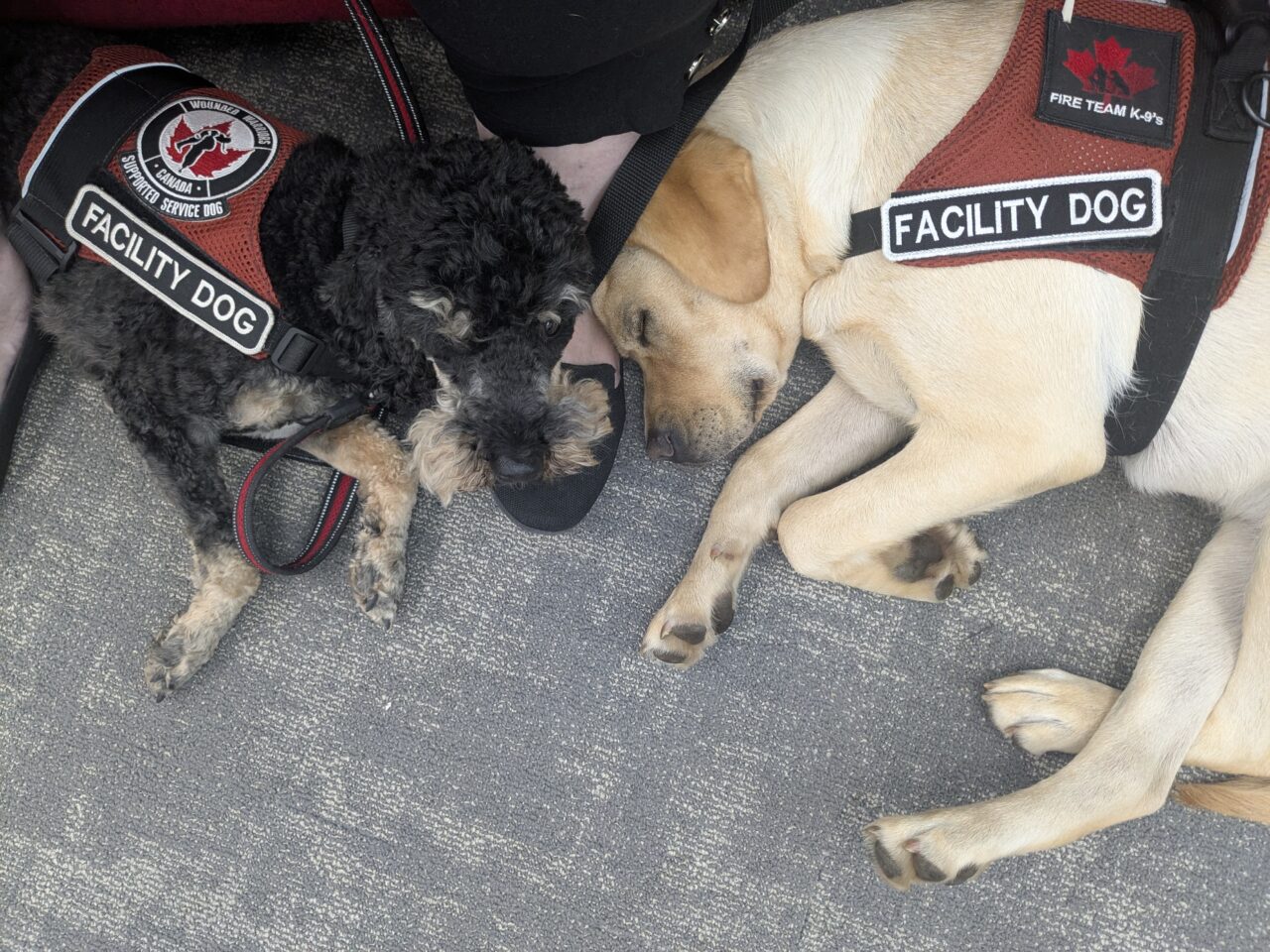
Researchers at the University of British Columbia explored these experiences through interviews with eight RCMP employees who had participated in a canine-assisted wellness program at the Kelowna Detachment.
Their findings help explain why participants valued the opportunity to spend time with therapy dogs during their working day.
What Employees Reported
In the 2021 qualitative study, Green and Binfet interviewed eight employees about workplace stress, coping resources, and their experiences with the therapy dog program.
Participants described the intervention positively, identifying opportunities to take a break from their responsibilities, experience stress relief, improve their mood, and shift their perspective.
The accompanying Kingston Police Service proposal summarizes the interview findings as follows:
- Six of eight employees, or 75%, reported stress relief.
- Seven of eight, or 87.5%, described an opportunity to take a break or recharge.
These percentages refer to eight interview participants, not the entire detachment. They should be understood as descriptions of a small group’s experiences.
The published qualitative study supports the broader themes of stress relief, breaks, mood, and perspective. The precise percentage breakdowns above are taken from the proposal’s summary of the research.
The Value of Changing Perspective
One of the more interesting findings was that employees described being able to shift their attention away from workplace concerns.
A demanding environment can require sustained concentration on problems, risks, and responsibilities. An opportunity to redirect attention toward an enjoyable activity may provide a temporary change in how someone experiences that environment.
For some participants, interacting with the dogs offered that opportunity.
The researchers also found that employees discussed organizational stressors more frequently than operational stressors.
That finding deserves attention.
Exposure to critical incidents is an important occupational mental health concern, but everyday working conditions also affect how employees experience stress.
A workplace wellness program needs to recognize both.
Why Dogs May Make These Opportunities Approachable
Spending time with a dog is an activity that can be enjoyed without needing to disclose personal information or explain emotional difficulties.
Employees can participate because they like dogs, want a break, or simply enjoy the opportunity to interact with the team.
The trained handler helps create a predictable environment and ensures that interactions are appropriate for both the participants and the dog.
In a facility dog program, these encounters may also create opportunities for informal conversation and connection.
The research does not establish that canine-assisted visits are more effective than every other type of workplace break. It does, however, provide evidence that participating employees valued the experience.
Recognizing the Limits of the Findings
Eight interviews cannot represent the experiences of all police personnel.
The participants were drawn from a single detachment and had already chosen to participate in the program.
Their responses help us understand what some employees found useful, but they cannot tell us how every employee would respond.
For organizations considering facility dog programming, the findings offer a starting point for designing and evaluating activities that employees find accessible and worthwhile.
The opportunity to step away, recharge, and return to work with a different perspective may be one useful part of a broader workplace mental health strategy.
References
Green, F. L. L., & Binfet, J.-T. (2021). Therapy dogs, stress-reduction, and well-being within the detachment: Interviews with law-enforcement personnel. Human-Animal Interaction Bulletin, 11(1), 10–35. https://doi.org/10.1079/hai.2021.0018
Binfet, J.-T., Draper, Z. A., & Green, F. L. L. (2020). Stress reduction in law enforcement officers and staff through a canine-assisted intervention. Human-Animal Interaction Bulletin, 8(2), 34–52. https://doi.org/10.1079/hai.2020.0011
