For some first responders, approaching a mental health professional can feel like a significant step.
There may be uncertainty about what the conversation will involve, concerns about confidentiality, or questions about whether the professional understands the demands of their occupation.
One potential application of facility dog programming is to create opportunities for employees to become familiar with mental health professionals before they require formal clinical services.
Research involving canine-assisted workplace wellness provides a useful starting point for exploring this possibility.
What the Research Demonstrates
In 2018, researchers from the University of British Columbia introduced a therapy dog program at the Kelowna RCMP Detachment.
During the eight-week pilot, 120 employees made 251 visits with trained therapy dogs and their handlers.
Participants reported statistically significant reductions in perceived stress immediately following their visits.
A subsequent qualitative study involving eight RCMP employees found that participants valued the opportunity to take a break, reduce stress, improve their mood, and shift their perspective.
These studies demonstrate that employees participated in the on-site canine-assisted intervention and generally described their experiences positively.
They did not measure whether the program increased access to psychotherapy or improved relationships with mental health professionals.
Creating Opportunities for Familiarity
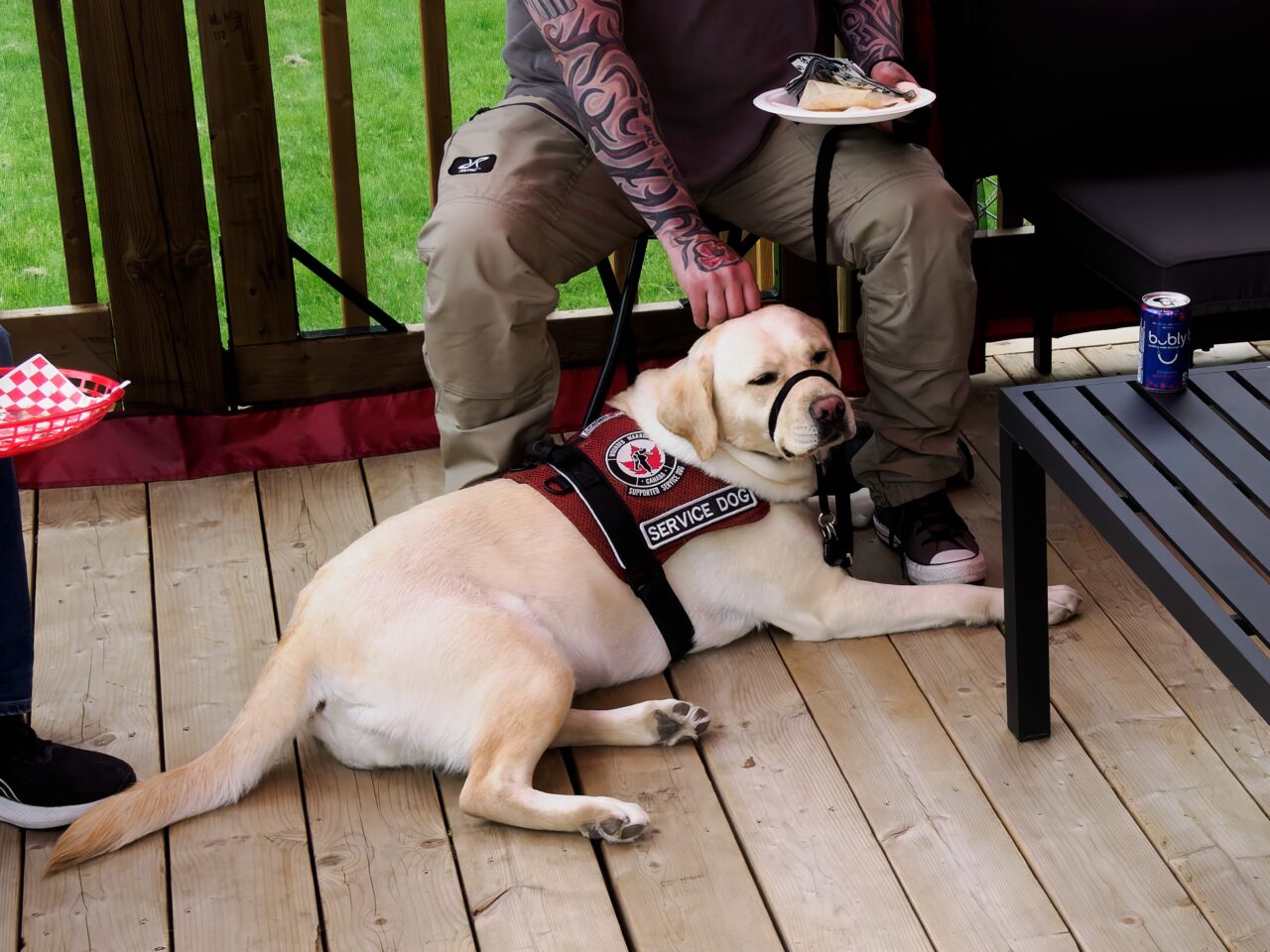
Consider a facility dog working alongside a qualified mental health professional within a police service, fire department, paramedic organization, or veterans’ support program.
An employee might initially stop by because they enjoy spending time with dogs.
During the interaction, they have an opportunity to meet the handler, learn about available services, and become familiar with the professional without needing to discuss personal concerns.
Over time, repeated encounters could provide opportunities for greater familiarity.
If the employee later wants psychological support, they may already know someone who can explain the available resources or assist with an appropriate referral.
This is a plausible program-development approach, but its effectiveness needs to be evaluated.
The existing research does not establish that interacting with a facility dog increases subsequent help-seeking or improves therapeutic relationships.
The Importance of the Handler
The qualifications and responsibilities of the handler are central to this type of programming.
A facility dog can provide opportunities for engagement, but the dog does not independently assess mental health, provide psychotherapy, or determine whether someone requires clinical treatment.
Those responsibilities remain with appropriately qualified professionals.
A facility dog handler working in a mental health setting must understand the purpose of the intervention, maintain professional boundaries, and recognize when a participant may require additional support.
Where clinical services are provided, informed consent, confidentiality, documentation, and professional scope of practice must be addressed.
The dog’s welfare must also remain part of every decision about participation.
How Could We Evaluate This Approach?
Organizations interested in this model can examine more than attendance.
Program evaluation might include whether employees understand the services available to them, whether they feel comfortable approaching program staff, and whether participation creates appropriate opportunities for referrals.
It could also examine whether employees who participate in canine-assisted activities subsequently access professional mental health services when needed.
These outcomes would need to be measured directly.
Participant feedback, professional observations, and canine welfare assessments can provide additional information about how the program operates.
A Role Worth Investigating
The Kelowna research provides evidence that brief canine-assisted visits can reduce immediate perceived stress and attract employee participation.
It also raises questions about how dogs and qualified handlers might be integrated into broader workplace mental health services.
For Fire Team K9, this is an important area of program development.
The intervention involves the partnership between the trained dog and the skilled handler, working together within an appropriate professional framework.
Understanding how that partnership may influence engagement, access, and psychological well-being will require continued evaluation.
References
Binfet, J.-T., Draper, Z. A., & Green, F. L. L. (2020). Stress reduction in law enforcement officers and staff through a canine-assisted intervention. Human-Animal Interaction Bulletin, 8(2), 34–52. https://doi.org/10.1079/hai.2020.0011
Green, F. L. L., & Binfet, J.-T. (2021). Therapy dogs, stress-reduction, and well-being within the detachment: Interviews with law-enforcement personnel. Human-Animal Interaction Bulletin, 11(1), 10–35. https://doi.org/10.1079/hai.2021.0018
