Protective Factors for Veterans and First Responders Mental Health| Fire Team K9
Self-efficacy refers to a person’s belief in their ability to organize and carry out actions needed to manage particular situations.
It develops through experience, learning, feedback, and opportunities to practise skills.
For veterans and first responders, occupational experiences can involve situations where control is limited and outcomes are unpredictable. Opportunities to experience competence and meaningful choice can therefore be valuable.
Research on early psychosocial interventions following trauma identifies self-efficacy and community efficacy among five important principles for supporting recovery (Hobfoll et al., 2007).
Self-efficacy should not be confused with the belief that individuals can control every outcome. It involves recognizing where actions and decisions can make a difference.
Where Dogs Can Participate
Dog training offers opportunities to practise skills with observable feedback.
Participants can learn to communicate a cue, observe the dog’s response, adjust their approach, and recognize progress.
A successful training exercise may provide a concrete experience of learning and mastery.
A facility dog handler can structure activities so participants work toward achievable goals, while ensuring that the dog remains comfortable and willing to participate.
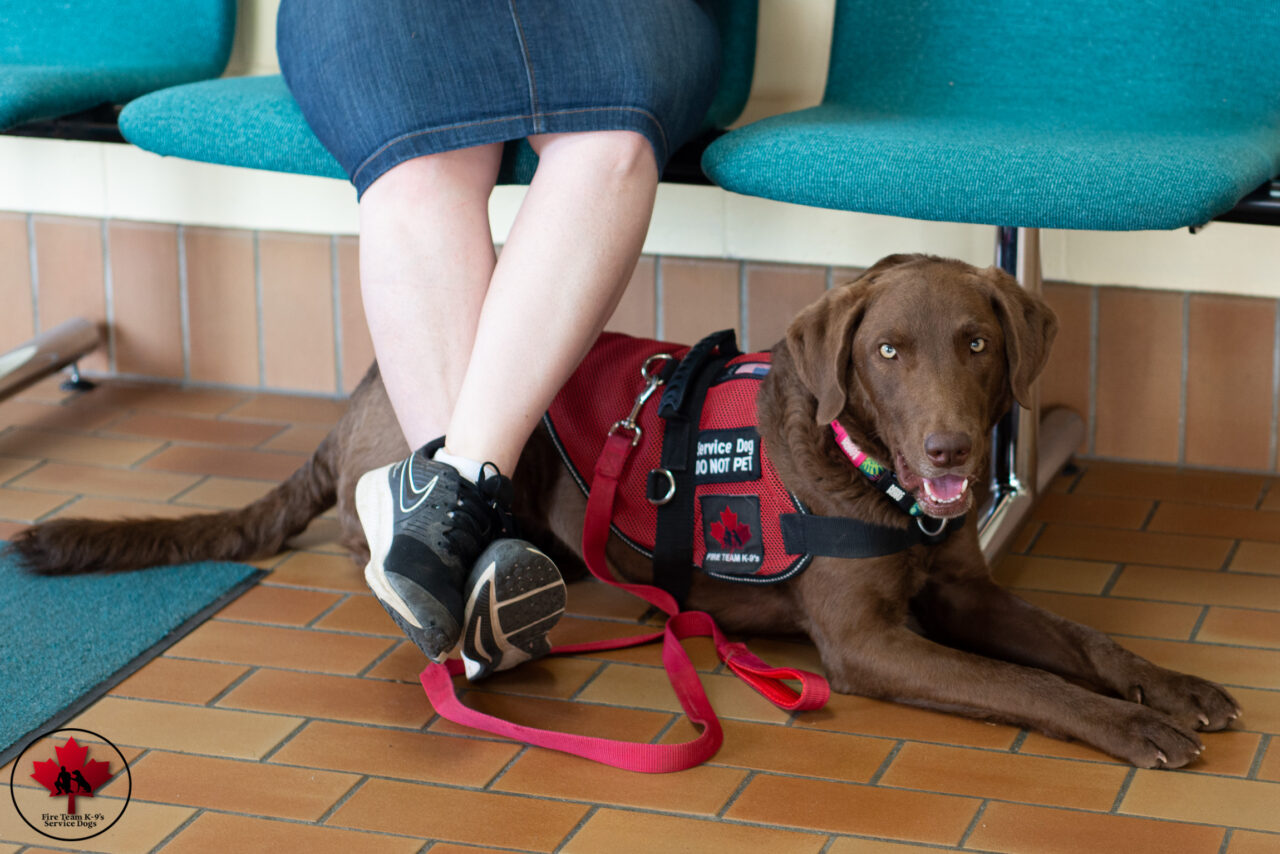
Service dog handlers may also develop confidence through learning to communicate effectively with their dogs and incorporate trained tasks into everyday routines.
However, although these activities are consistent with established principles of mastery-based learning, research has not established that dog training independently prevents occupational PTSD through improvements in self-efficacy.
Putting the Protective Factor Into Practice
A simple training activity can involve teaching or practising a familiar cue.
Participants begin with an achievable task, observe the result, and adjust their communication as needed.
The exercise can then be connected to everyday experiences of problem-solving, learning, and adapting to challenges.
Success is measured through participation, learning, and appropriate responses rather than demanding flawless performance from either the person or the dog.
A question to consider: What is one skill you have developed through practice that once seemed difficult?
References
Hobfoll, S. E., et al. (2007). Five essential elements of immediate and mid-term mass trauma intervention: Empirical evidence. Psychiatry, 70(4), 283–315. https://doi.org/10.1521/psyc.2007.70.4.283
Leighton, S. C., et al. (2024). Service dogs for veterans and military members with posttraumatic stress disorder. JAMA Network Open, 7(6), e2414686. https://doi.org/10.1001/jamanetworkopen.2024.14686
Evidence note: The dog-training application is an educational approach informed by self-efficacy theory. Its effectiveness for preventing occupational stress injuries requires direct evaluation.
